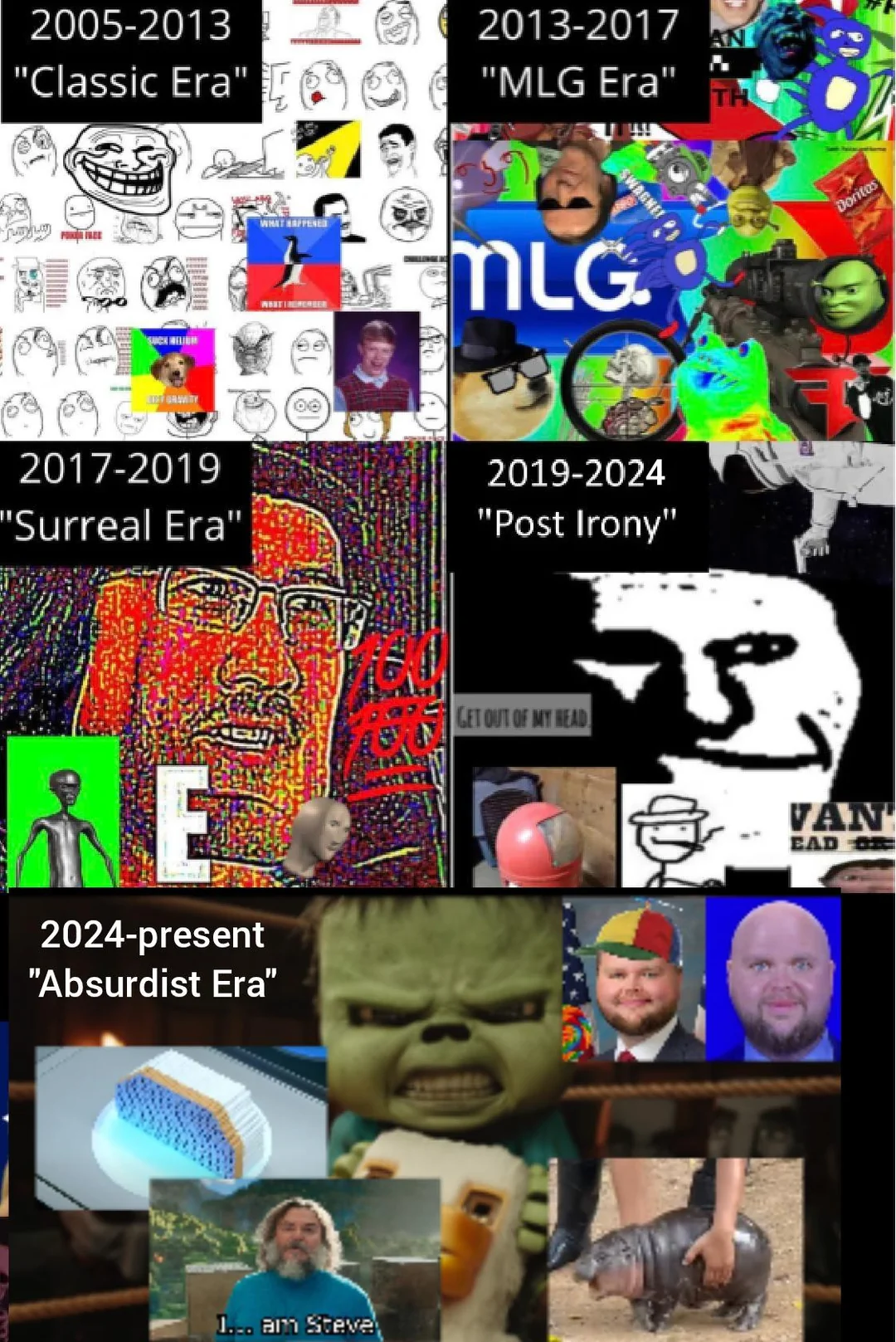
The word "meme" was coined by Richard Dawkins in 1976 to describe a unit of cultural transmission — an idea that spreads through imitation. For the first three decades after its coinage, the concept was confined to academic circles. Then the internet happened, and memes stopped being a theoretical construct and became an empirical reality so pervasive and fast-moving that the original theory struggles to keep up.
The internet meme's evolutionary timeline is not a straight line. It's a series of mutations, reversals, irony layers, and genuine cultural breakthroughs. To trace it properly requires acknowledging that memes are not just jokes. They are the primary vehicle through which the internet processes shared experience.
Generation One: The Image Macro (2003–2010)
The first distinctive internet meme format was the image macro: a photograph with bold Impact font text, usually arranged as top text/bottom text. LOLcats. Advice animals. The Most Interesting Man in the World. "All Your Base." These were legible, replicable, instantly graspable. The humor was often basic but reliable: the image established context, the text delivered the joke.
What made image macros culturally significant was their democratization of meme creation. Before internet memes, cultural production required access to broadcast media. Image macros required Microsoft Paint and a 56k connection. Anyone could participate in the production of culture, and millions did.
"The image macro was the folk song of the early internet — anonymous, iterative, collectively owned, infinitely remixed."
Generation Two: Reaction Media and Cultural Specificity (2009–2014)
As internet culture matured and the population online diversified, memes became more specific. GIFs, reaction images, and Tumblr-native formats developed richer contextual requirements. Understanding a reaction image required knowing its source. Tumblr's fandom ecosystem produced memes that operated entirely within fan communities — invisible to outsiders, richly legible to insiders.
This period introduced the meme as cultural passport. Knowing a meme signaled membership. The humor wasn't just in the content but in the recognition — the feeling of being in a group that shared a reference. Memes became a mechanism for community formation and identity expression simultaneously.
Generation Three: The Irony Spiral (2014–2018)
Something strange happened around 2014. Memes began eating themselves. The "dank meme" era introduced increasingly self-aware, self-referential, and deliberately obscure humor. What started as irony — jokes that knew they were jokes — accelerated into post-irony and then into something harder to name.
The "deep fried" meme aesthetic — images deliberately degraded, over-saturated, with excessive JPEG compression — was a parody of the image quality typical of shared memes that became, through constant use, a genuine aesthetic mode. Surreal humor flourished. Memes involving scenarios with no conventional punchline, with deliberately unfunny delivery, with self-aware acknowledgment that the meme was bad — these became increasingly popular.
Cultural critics were baffled. What they were observing was a community that had processed sincerity into irony, irony into post-irony, and was now in the process of coming back around to something that functioned like sincerity but was insulated from it — emotional expression with plausible deniability built in.
Generation Four: The Emotional Confession (2018–Present)
The Wojak cycle represents something genuinely new in meme history. The crude MS-Paint figure — a bald, featureless white man with a vaguely sad expression — became the vessel for some of the most authentic emotional disclosure in internet culture. "Feels guy." "Doomer." "NPC." The Wojak format produced a taxonomy of psychological states that resonated with millions of people who had never had adequate language for the experiences described.
This is the paradox of post-irony: the distance it created became the condition under which genuine feeling could be expressed. The meme format, explicitly labeled as meme, carrying the implicit signal "this is not serious," created a space in which genuine pain, loneliness, anxiety, and yearning could be communicated and recognized.
Understanding meme evolution means understanding that the medium is never just the vehicle for humor. It's the primary cultural form through which a generation processes what it's like to be alive in the networked age. The jokes are real. The feelings underneath them are realer still.