There is a photograph that circulates endlessly in certain corners of the internet. It shows a stretch of yellow-carpeted corridor, fluorescent-lit, empty, that appears to extend forever into soft focus. There are no windows. No exits visible. No signs of recent human occupation — just carpet and light and the kind of institutional beige that suggests a building designed not to be noticed. The image is deeply, inexplicably familiar. It feels like a memory of something that probably never happened. And somehow, looking at it, many people feel a strange comfort.
This is a liminal space. The term was borrowed from anthropology, where it describes transitional states — thresholds between one condition and another, doorways and midnights and the moment between sleeping and waking. When it was adopted by internet aesthetics communities around 2019 and 2020, it came to describe a more specific phenomenon: photographs, rendered environments, and illustrated scenes that depict transitional or interstitial human environments — corridors, malls, swimming pools, hotel lobbies, playgrounds at dusk — emptied of their expected human occupants. The aesthetic began, roughly, with a single 4chan post: an image of that yellow carpeted hallway, captioned "if you're not careful and you noclip out of reality in the wrong areas, you'll end up in the Backrooms." The Backrooms — that first specific liminal space — became a cultural touchstone. But the broader aesthetic it kicked off was tapping into something that was already there, waiting to be named.
The question is: what was already there? What is the emotional register of liminal-space aesthetics, and why does it resonate so strongly, so widely, across such a diverse audience? Why do we find comfort — not horror, not anxiety, but something that feels close to relief — in images of empty spaces that should feel lonely or threatening?
The Grammar of the Liminal
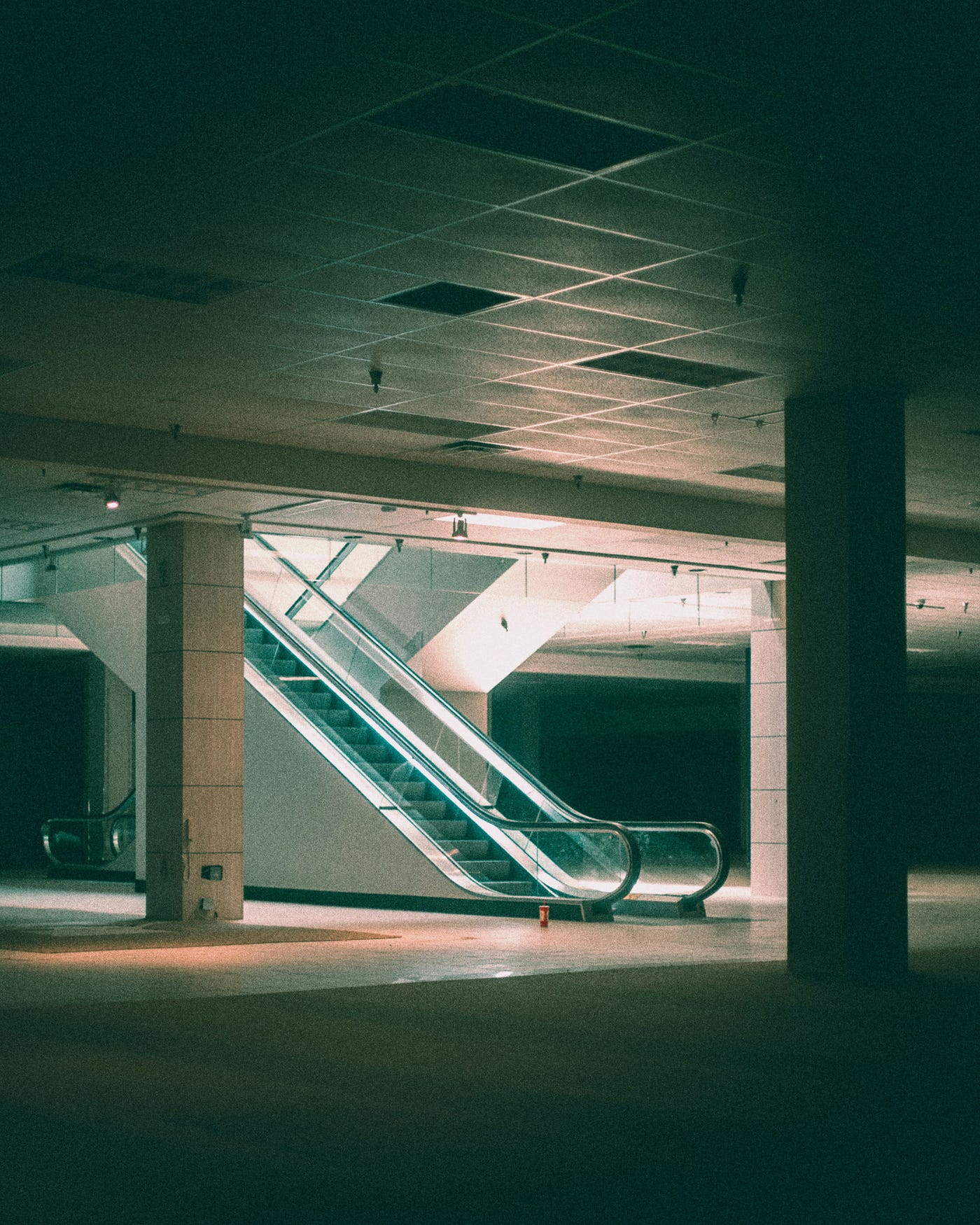
A liminal space, to work aesthetically, requires several elements operating together. First: recognisability. The space must be somewhere we have been before — or somewhere so similar to a place we have been that it activates memory. The specific images that circulate most widely as liminal spaces are not exotic or unusual locations. They are the most banal architecture imaginable: shopping mall food courts, office building corridors, school gymnasiums, neighborhood playgrounds, municipal swimming pools, hotel hallways. The building blocks of ordinary life in wealthy postwar societies. Places so unremarkable that we passed through them without registering them, and yet the infrastructure of thousands of afternoons.
Second: emptiness. The space must be devoid of people — but not in a way that suggests catastrophe. There are no signs of violence, no evidence of sudden departure. The lights are on. The carpet is intact. The pool water is still, blue, maintained. Whatever happened, it was orderly. The people simply... are not here. They might have been here. They will perhaps be here again. But they are not here now.
Third: an eerie quality of suspended time. Liminal spaces exist in a kind of perpetual present — a "now" that has no before or after visible in the frame. There are no temporal cues that would allow you to place the image. The fluorescent lights could have been installed last year or thirty years ago. The carpet pattern is one that existed in the 1970s and still exists today. You cannot tell whether the mall is open or closed, whether it is 11am or 3am. The space floats.
These three elements together produce the distinctive emotional experience that fans of the aesthetic describe in strikingly consistent language: a feeling of memory without content; a sensation of almost-recognition; something they variously describe as "nostalgic," "dreamlike," "uncanny," or, most revealingly, "familiar."
Memory Without Event
The philosopher Svetlana Boym distinguished between two forms of nostalgia: restorative nostalgia, which mourns a specific lost home and wants it back; and reflective nostalgia, which dwells on the feeling of longing itself, without a clearly defined object. Liminal-space aesthetics are almost purely an expression of the second type. The person looking at the yellow corridor is not thinking of a specific corridor they once walked down. They are experiencing the feeling of remembering, without any particular memory attached to it.
This is a peculiar state. We are activating the emotional architecture of memory — the specific warmth and sadness of recollection — without filling it with specific content. We are nostalgic for nothing in particular. And this turns out to be, for many people, immensely pleasurable. Perhaps more pleasurable, in a way, than actual nostalgia for specific things — because the specific thing is always imperfect, always mixed with difficulty and loss, while the pure feeling of remembering-without-content is uncontaminated. It is nostalgia as sensation rather than as grief.
The mundane architecture of liminal spaces is crucial here. They could not do this work if they depicted unusual or beautiful or significant places. It is precisely because they depict the forgotten infrastructure of ordinary life — the places we passed through without noticing — that they can evoke this pure-feeling memory. We stored no strong memories there. Which means we can project onto them freely. They become screens for our feeling of the past without being contaminated by the specific past.
The Comfort of No One Being There
I want to push back gently against the common framing of liminal spaces as "eerie" or "uncanny." These words are accurate, but they can obscure something important. For a significant portion of the audience that engages with this aesthetic, the emptiness is not threatening. It is a relief.
There is a social register to liminal spaces that I think is underexamined. The places depicted — shopping malls, playgrounds, public pools, office corridors — are, in their normal state, demanding environments. They require social performance. In the shopping mall you may be seen, judged, expected to want things and demonstrate that wanting appropriately. The playground involves the complex politics of childhood. The office corridor is traversed in relation to colleagues and hierarchies. These spaces are, in their usual form, saturated with social demand.
The liminal-space version of these places removes all of that. There is no one to see you. No one to judge you. No expectation to perform. The mall at 3am, with no one there, is suddenly a completely different kind of space — one in which you could be purely present, without the labor of social existence. Many people who describe finding liminal spaces comforting cite, when pressed, something like this: a feeling of release. "You could just be there," wrote one Tumblr user in a widely reblogged post. "No one to impress. Nothing expected. Just the space and you."
This reading resonates particularly strongly given the audiences that took up liminal-space aesthetics most enthusiastically. Adolescents, young adults, people who experience social anxiety, autistic people, introverts — all are significantly represented in the communities that developed around this aesthetic. For people for whom social existence is effortful or anxiety-producing, the empty space is not a horror but a fantasy: what it would feel like to have the whole world to yourself, without the cost of other people having left it.
The Backrooms and the Internet's Specific Loneliness
The specific mythology that grew around the Backrooms — the idea of "noclipping out of reality" into an infinite series of empty corridors — tells us something about where this aesthetic emerged and who it speaks to most directly. The noclip glitch is a video game mechanic: in first-person games, it allows you to move through walls and floors, escaping the designed play space into the void beneath. You are outside the world that was made for you, in a space that was not designed to be experienced.
The framing is telling. The people who most powerfully respond to liminal-space aesthetics are, very often, people who feel slightly outside the designed world — who have noclipped, in some sense, out of the mainstream social experience. They are people who spent significant time online, in the half-lit spaces of the early internet, in forum communities and games and chatrooms that were invisible to their offline peers. They are people for whom the "real world" has always felt slightly foreign, slightly designed for someone else. The liminal space is not frightening because it already feels like home.
There is a specific quality of internet loneliness — not a bad loneliness, not necessarily, but a distinctive one — that liminal-space aesthetics capture with unusual precision. It is the feeling of being awake at 3am, alone in a room lit only by a screen, communicating with people who are also awake at 3am in rooms lit only by screens, in a kind of shared solitude that is both isolating and intimate. It is a particular texture of experience that was not available before the internet existed, and that the internet enabled on a mass scale. And it looks like: everywhere empty, fluorescent lights on, the whole building yours for no particular reason, and somewhere in the distance the low hum of systems running that no one is currently watching.
What We Are Actually Longing For
I think the deepest appeal of liminal-space aesthetics is not nostalgia, and not social relief, but something more specific: the fantasy of unhurried time. The empty mall is not just empty of people. It is empty of demand. No task to perform. No schedule to meet. No optimised content to consume. The space simply exists, and you can be in it, without the space requiring anything of you.
We are living through a period of extraordinary temporal pressure. The attention economy has colonised every spare moment — every pause, every transitional moment, every liminal space in our actual lives has become an opportunity for content delivery. The elevator has a screen. The waiting room has Wi-Fi. The commute is a podcast slot. The thirty seconds before sleep is a TikTok scroll. We have outsourced our liminal time to platforms, and the platforms have filled it with demands for attention and emotional response.
The liminal space as aesthetic object offers us back something we have lost: an image of transitional time that is not filled. A corridor that is just a corridor. A pool that is just water and light. A moment of in-between that belongs to no one and makes no demands. We cannot live in these images, but we can rest in them for a moment, in the same way that we might rest in an early memory — before the world became organised and demanding and always already full.
This is, I think, why the aesthetic resonates so strongly with the specific generation that grew up with the early internet and came of age in the algorithmic era. They remember a kind of online time that was more like the liminal space: the empty, meandering, purposeless browsing of Web 1.0, when you might spend an afternoon following links to nowhere in particular, because nowhere in particular was available and had not yet been optimised. That internet is gone. What remains is the image of the empty corridor, the pool at dawn, the mall before it opens — and the feeling that there was once more space than this, and less of it was owned.
The Aesthetic and What It Demands of Us
Liminal-space aesthetics ask almost nothing of their audience. This is not a criticism — it is part of their function. Unlike most internet content, which requires reaction (share this, be outraged by that, express your devotion here), the liminal image simply sits. It invites you to look. It does not tell you what to feel. It does not call for engagement or comment or rating. It is, in the attention economy, a remarkable kind of object: content that does not optimize for interaction.
The communities that formed around liminal spaces — r/LiminalSpace, various Tumblr archives, YouTube essays, collaborative Backrooms wikis — developed an etiquette that reflected this. Comments tend toward the reflective and the personal. People describe their own emotional responses without demanding that others agree. There is unusual tolerance for divergent readings. Some people find the images peaceful. Others find them melancholy. Others find them genuinely frightening. The community does not police these responses. The image makes room for all of them.
This is, in a small way, an aesthetic education in how to tolerate ambivalence. The liminal space does not resolve. You cannot decide how to feel about it and close the tab satisfied. It persists in a state of unresolved feeling — comfortable and strange, familiar and wrong, comforting and empty. And sitting with that unresolved feeling is itself a small act of resistance to a cultural environment that relentlessly demands clarity, reaction, and rapid emotional processing.
The yellow corridor goes on forever. The pool water doesn't move. The lights stay on for no one. And somehow, looking at it, you feel like you might have been there once, in a time when time moved differently, when being somewhere required nothing more than being there. Perhaps you were. Perhaps everyone was, once. The aesthetic just helps us remember the feeling, if not the place.